
Bispecifics and Bioanalysis: Navigating Complexity with Custom Assays
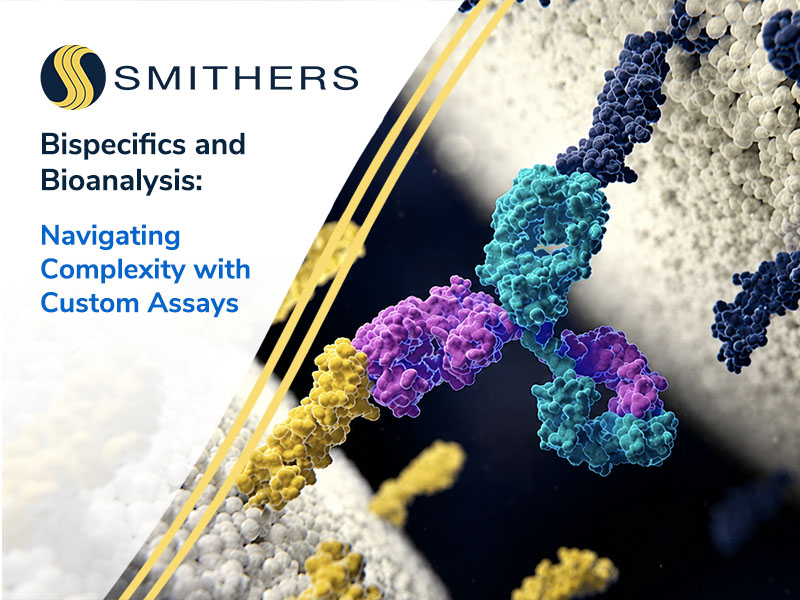
Bispecific therapeutics continue to reshape biologic drug development. These engineered molecules are designed to interact with two distinct targets simultaneously, creating new opportunities to develop treatments for cancers, autoimmune disorders, infectious diseases, eye diseases, and some neurological and inflammatory conditions. Their structural complexity also introduces new bioanalytical challenges that traditional monoclonal antibody strategies were not designed to address.
Successful bispecific development requires a bioanalytical partner with experience in custom assay development, method optimization, and complex biologic characterization. Smithers Pharmaceutical Development Services supports sponsors with tailored bioanalytical strategies designed to address the unique behavior of bispecific molecules throughout the drug development lifecycle.
Why Bispecific Therapeutics Create Bioanalytical Complexity
Traditional monoclonal antibodies are designed around a single target. Bispecific therapeutics contain multiple binding regions with distinct biological functions. This increases the complexity of pharmacokinetic assays, immunogenicity testing, target interference analysis, and long-term sample stability assessments.
Key challenges for LBA-based PK assays could include selection of suitable capture and detection reagents, management of target and matrix interference, and maintaining assay sensitivity, specificity, and robustness. In addition, differences in binding behavior between the two arms of the molecule may impact accurate drug quantitation and overall PK assessment.
Because bispecific molecules interact with multiple targets, interference patterns can become difficult to isolate and characterize. Binding events may behave differently depending on assay conditions, circulating targets, or matrix composition.
Immunogenicity assessment for bispecific therapeutics is more complex than for conventional monoclonal antibodies because immune responses may target different domains of the molecule. As a result, ADA assay development may require multiple positive controls and expanded specificity characterization to evaluate responses against distinct binding regions. Sponsors should assess how these diverse ADA populations affect assay sensitivity, specificity, and overall assay performance. More importantly, ADA responses against different regions of the bispecific molecule may alter the PK profile, reduce drug exposure, neutralize biological activity, and ultimately impact therapeutic efficacy.
As biologic engineering becomes more advanced, molecular stability can also become more difficult to manage. Some bispecific constructs may exhibit increased sensitivity to storage conditions, sample handling procedures, or assay environments. These variables can influence method reproducibility and long-term analytical performance if not properly addressed during development.
Standard Assays Require Customization for Bispecific Molecules
Platform assay approaches remain valuable in biologics development, but bispecific therapeutics often require significant optimization to achieve reliable performance.
Custom assay development begins with understanding the structure and behavior of the therapeutic itself. Assay sensitivity, specificity, capture reagents, detection reagents, incubation conditions, and buffer composition must all be evaluated based on the characteristics of the molecule.
Bispecific therapeutics can also create opportunities during assay design. Their dual-binding architecture may allow developers to create highly specific capture and detection strategies that improve assay selectivity. The challenge lies in identifying the correct assay conditions to support consistent and reproducible performance.
Optimization often involves adjusting assay parameters such as incubation time, temperature, reagent concentration, shaking conditions, and matrix composition. Small changes can significantly affect assay behavior, particularly when multiple targets or binding domains respond differently under the same experimental conditions.
The result is not the replacement of standard platforms, but the customization of assay strategies to support complex biologic behavior.
Custom Assay Development Supports Reliable Bioanalysis
Custom bioanalytical strategies are driven by sponsor goals, molecule characteristics, and regulatory expectations. Each program requires a balance between sensitivity, specificity, throughput, and operational feasibility.
Smithers Pharmaceutical Development Services works closely with sponsors to define assay objectives early in development. This collaborative approach allows teams to evaluate potential analytical risks before they impact study timelines or regulatory milestones.
Assay development for bispecific therapeutics may include customized pharmacokinetic assays, anti-drug antibody assays, neutralizing antibody assays, or multiplexed approaches capable of evaluating multiple targets simultaneously.
Complex assays often require extensive troubleshooting during development. Some molecules behave differently depending on assay conditions or biological matrices. Others may demonstrate varying stability profiles during sample handling or long-term storage. Early evaluation of these variables improves method robustness and reduces downstream risk.
Smithers Pharmaceutical Development Services supports these programs with experienced bioanalytical scientists who understand the technical and operational challenges associated with complex biologics. This experience allows teams to anticipate issues, optimize assay performance, and support method transfer across development stages.
Multiplexed and Ultra-Sensitive Technologies Expand Analytical Capabilities
Complex biologics frequently require advanced analytical platforms capable of supporting highly specific and sensitive measurements.
MSD platforms remain widely used for many bioanalytical applications due to their flexibility, reproducibility, and compatibility with global laboratory environments. Standardized instrumentation also simplifies assay transfer and cross-laboratory comparability during later-stage development.
Ultra-sensitive technologies continue to expand bioanalytical capabilities for difficult molecules and low-abundance analytes. Smithers Pharmaceutical Development Services supports assay development using technologies such as AlphaLISA, which enables solution-based detection without requiring plate-bound protein interactions. These approaches can provide advantages for select biologics where traditional assay formats introduce analytical limitations.
The value of advanced instrumentation depends on how effectively assay conditions are optimized around the molecule itself. Platform selection alone does not solve assay complexity. Successful development requires experience in adapting assay design to the behavior of the therapeutic.
Early Bioanalytical Strategy Reduces Development Risk
Sponsors benefit from engaging a bioanalytical partner during the earliest stages of development. Early assay planning provides greater flexibility for method optimization, reagent evaluation, and analytical characterization before regulatory timelines become restrictive.
Discovery-stage collaboration can also accelerate later development activities. Early assay frameworks often establish the foundation for nonclinical and clinical methods, reducing redevelopment requirements as programs progress.
Understanding how a molecule behaves across different species, matrices, and study conditions improves long-term development planning. Early analytical characterization also helps identify potential interference patterns, stability concerns, and assay limitations before they impact critical studies.
Clear communication between sponsors and bioanalytical teams remains essential throughout development. Successful programs depend on realistic timelines, transparent data interpretation, and a shared understanding of assay expectations and molecule behavior.
Experience Matters in Complex Biologic Development
Bispecific therapeutics continue to evolve as biologic engineering advances. Molecules are becoming more targeted, more structurally complex, and more analytically demanding. Bioanalytical strategies must evolve alongside them.
Smithers Pharmaceutical Development Services supports sponsors with custom assay development, method optimization, immunogenicity testing, pharmacokinetic analysis, and troubleshooting strategies designed specifically for complex biologics. The team combines technical expertise with practical experience across discovery, nonclinical, and clinical development programs.
Continuous learning also remains critical in this rapidly changing field. Scientists at Smithers Pharmaceutical Development Services maintain active involvement in scientific conferences, industry collaboration, and emerging bioanalytical technologies to support evolving sponsor needs and regulatory expectations.
Partner with Smithers Pharmaceutical Development Services
Bispecific therapeutics require bioanalytical strategies built around the complexity of the molecule. Assay performance, analytical reliability, and development timelines depend on early planning, technical expertise, and customized method development.
Smithers Pharmaceutical Development Services provides bioanalytical support for complex biologics from discovery through late-stage clinical development. Sponsors gain access to experienced scientists, flexible assay strategies, and collaborative project support designed to reduce development risk and accelerate progress.
To discuss bioanalytical support for bispecific therapeutics or other complex biologic programs, schedule a meeting with Smithers Pharmaceutical Development Services today.

