USP <665>
Plastic Components and Systems Used to Manufacture Pharmaceutical Drug Products and Biopharmaceutical Drug Substances and Products

USP <665>, Plastic Components and Systems Used to Manufacture Pharmaceutical Drug Products and Biopharmaceutical Drug Substances and Products, which became official on 1st May 2026, provides an informational risk-based framework for assessing plastic manufacturing components used throughout pharmaceutical and biopharmaceutical production. Supporting chapter USP <1665> provides additional scientific rationale and guidance on how to perform risk assessments, apply characterization strategies of an appropriate scale, and justify qualification decisions regarding the testing of manufacturing components.
Manufacturing processes involve numerous points of contact where compounds might migrate from the plastic components of the manufacturing system into the process stream. If these compounds remain in the process stream, they may ultimately appear in the final drug product as PERLs. These compounds have the potential to impact the quality, efficacy, and safety of the drug product.
In addition to the potential toxicity of leachable compounds, they may also affect patient safety both directly via undesirable immune responses, and indirectly through potential negative impacts on the efficacy of the drug product, e.g. via protein aggregation or degradation. This is of particular concern for biologics and advanced therapies, where product quality may be sensitive to even low levels of contaminants. Regulatory expectations increasingly emphasize risk-based assessment, analytical characterization of components, and toxicological evaluation to ensure manufacturing systems are suitable for their intended use.
USP <1665>, Characterization and Qualification of Plastic Components and Systems Used to Manufacture Pharmaceutical Drug Products and Biopharmaceutical Drug Substances and Products, is also referenced within the latest standard, USP <1067>, Best Practices for the Manufacture and Quality Control of Recombinant Adeno-Associated Virus Gene Therapy Products, which becomes official on 1st February 2027.
USP <665> applies to plastic components used in the manufacture of pharmaceutical drug products, and biopharmaceutical drug products and drug substances. Systems used for the manufacturing of non-biologic/non-biopharmaceutical Active Pharmaceutical Ingredients (APIs) precursors of drug products are out of scope, due to the various purification processes performed during the manufacture of these substances. The chapter covers both single-use systems (SUS) and multiple-use systems (MUS) where components come into contact with liquid or semi-solid process streams. Examples of manufacturing system components within the scope of USP <665> include:
Certain component types fall outside the scope of USP <665>, including auxiliary items with only brief contact times. Elastomer-based elastomeric components, such as some gaskets and O-rings, require assessment but also fall outside of the scope of USP <665>. Silicone elastomer components fall within the scope of USP <383> Cured Silicone Elastomers for Pharmaceutical Packaging and Manufacturing Components which becomes official on December 1, 2027, and for which USP permits early adoption.
One of the key principles of USP <665> is that not every component in a manufacturing system requires the same level of testing. Instead, Marketing Authorization Applicants are expected to perform a structured 2-stage assessment to determine the potential risk associated with each component.
Stage 1 consists of an initial assessment as detailed in Figure 1 below.
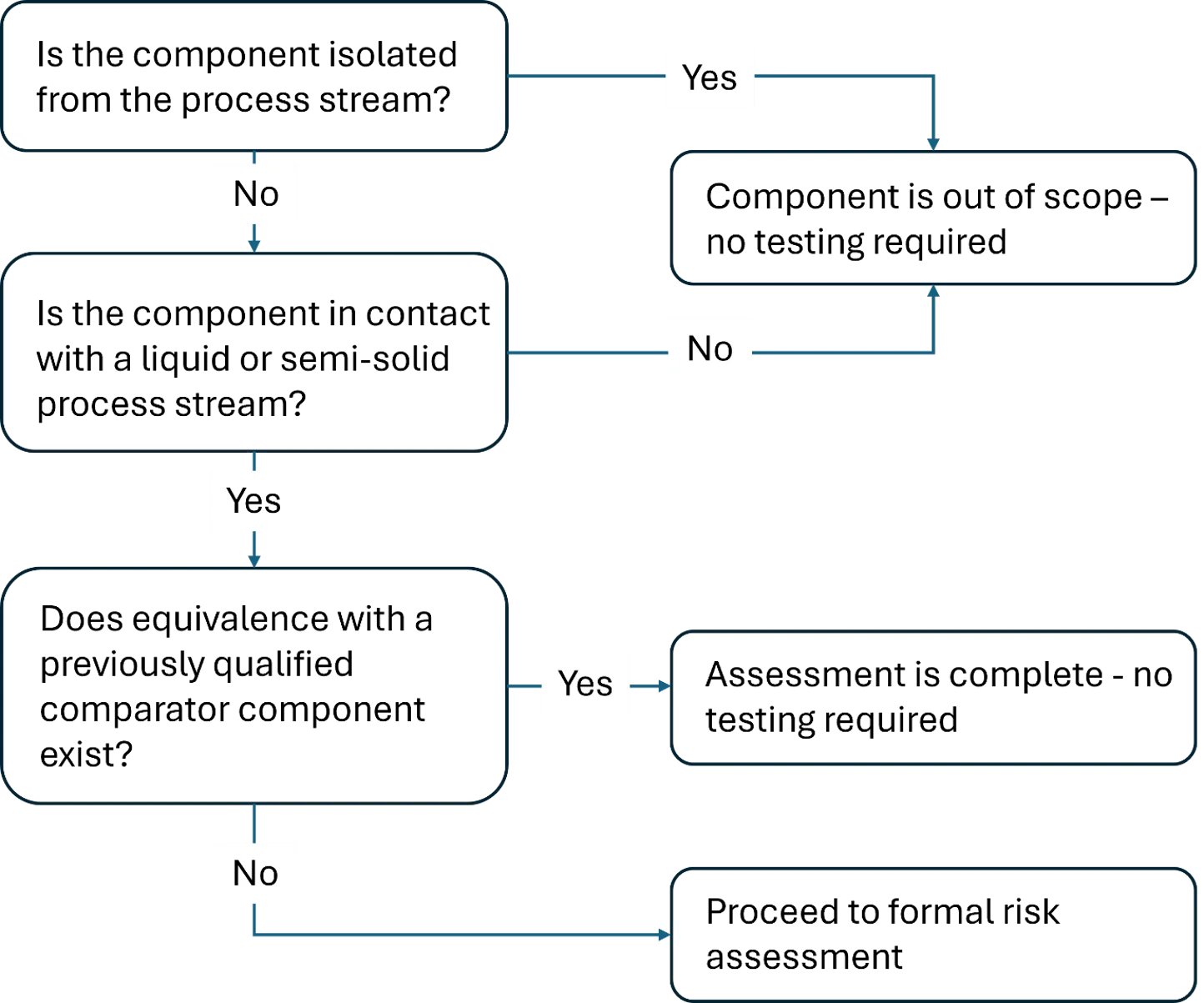
Figure 1 - Stage 1 assessment
If the component is isolated from the relevant process stream or does not contact a liquid or semisolid process stream, it is outside the scope of <665>. If justified equivalence to an acceptable comparator can be established, further chemical characterisation is not required. Otherwise, the component proceeds to a formal risk assessment.
Risk assessments consider factors including:
The outcome determines whether the component is categorized as low, moderate, or high risk, which in turn dictates the extent of chemical characterization required.
USP <665> links risk classification directly to testing expectations.
Low-Risk ComponentsLow-risk components require extraction using a 50:50 ethanol/water solution (Solution C1) followed by:
These tests provide high-level screening information regarding the overall extractables burden. The results may indicate that elevation of the risk level to moderate risk and associated additional testing is required. |
Moderate-Risk ComponentsModerate-risk components require organic extractables profiling using Solution C1. Analytical characterization is typically performed using complementary techniques capable of detecting volatile, semi-volatile, and non-volatile compounds. |
High-Risk ComponentsHigh-risk components require the most comprehensive evaluation, including:
|
This approach is designed to identify potential extractables that could emerge under a broad range of manufacturing conditions.
USP <665> provides detailed guidance on extraction study design. Standardized extraction conditions help generate meaningful challenging extractables while maintaining relevance to real-world manufacturing processes. The standard extraction protocol includes requirements for:
The guidance acknowledges that implementation of these extraction conditions may not always be possible due to practical considerations and recognizes that manufacturing environments may involve more aggressive conditions than the standard extraction protocol. In these instances, it allows scientifically justified alternate extraction approaches where appropriate.
While USP <665> focuses on component characterization through extractables studies, Marketing Authorization Applicants should also consider how extractables data integrate into broader leachables strategies.
A comprehensive Extractables and Leachables (E&L) program evaluates whether compounds identified during extractables testing migrate into the drug substance or drug product during manufacturing and storage, and whether following migration they are present in the product at a level considered to pose a risk to product quality or patient safety. Depending on the risk assessment and extractables findings, the broader E&L strategy may include toxicological assessment and, where warranted, targeted and/or non-targeted leachables studies. The ultimate goal is to ascertain that any leachables present in the product have a negligible impact on product quality and patient safety; if they do not, then mitigation will be required.
Successfully implementing USP <665> requires more than simply executing an analytical test. Manufacturers must develop defensible risk assessments, design appropriate extraction studies, interpret complex analytical data, and generate documentation that supports regulatory expectations.
At Smithers, our extractables and leachables specialists support pharmaceutical and biopharmaceutical organizations throughout the entire qualification process. From initial risk assessment and test strategy development through extractables characterization, toxicological review, and leachables assessments our team helps clients generate the scientific evidence needed to demonstrate the suitability of plastic manufacturing components and systems.
As regulatory scrutiny of manufacturing materials continues to evolve, a proactive USP <665> strategy can help reduce project risk, support regulatory submissions, and build confidence in the safety and quality of pharmaceutical products.
Need support with USP <665> compliance or component qualification? Contact Smithers E&L experts to discuss your manufacturing systems, risk assessment strategy, or extractables testing requirements.

.png?ext=.png)