
qPCR and ddPCR Capabilities for Today’s Cell and Gene Therapy Programs
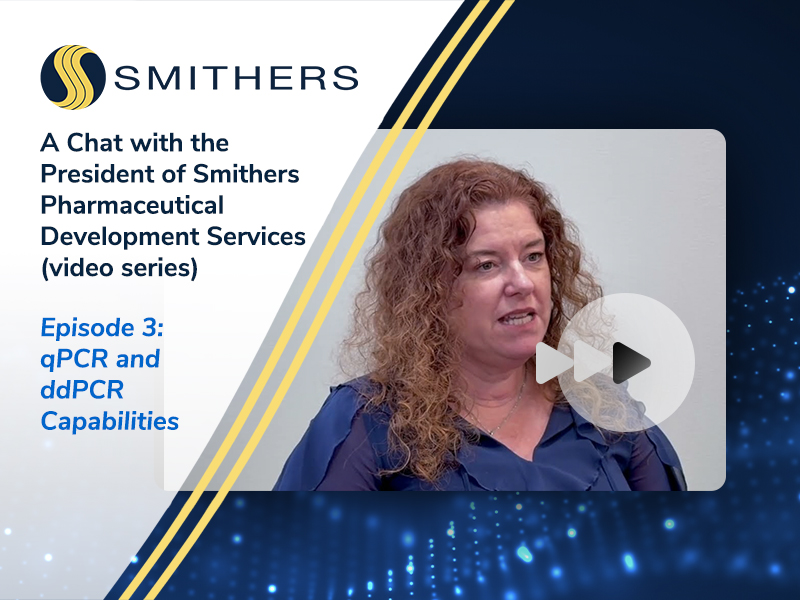
Flexible molecular biology platforms, experienced scientists, and rapid access to data help Smithers Pharmaceutical Development Services support increasingly complex therapeutic development programs.
As cell and gene therapies continue to advance, the analytical strategies required to support them are becoming increasingly sophisticated. Sponsors need more than access to sensitive molecular biology technologies. They need experienced scientists who can select and optimize the right approach, accommodate different therapeutic modalities and sample types, and deliver reliable data quickly enough to support critical development decisions.
At Smithers Pharmaceutical Development Services’ Ewing, New Jersey facility, quantitative PCR (qPCR) and droplet digital PCR (ddPCR) capabilities are part of a broader molecular biology offering developed through years of supporting cell and gene therapy programs. As Smithers PDS President Christina Satterwhite, PhD, introduces in the video above, the strength of these capabilities comes from combining advanced instrumentation with scientific expertise, flexible workflows, and an emphasis on getting meaningful data into clients’ hands quickly.
Choosing the Right PCR Approach for the Program
qPCR remains an important and widely used tool for sensitive detection and relative or absolute quantification of nucleic acid targets. Its combination of sensitivity, dynamic range, and established workflows makes it applicable across a wide variety of molecular biology studies.
ddPCR provides sponsors with another powerful analytical option. By partitioning samples into thousands of individual droplets and performing PCR reactions within those partitions, ddPCR enables absolute quantification without dependence on a standard curve. This approach can be particularly valuable when programs require highly sensitive and precise measurement of nucleic acid targets, including situations involving low target concentrations or relatively small differences between samples.
Having both qPCR and ddPCR capabilities available allows the Smithers team to approach each program based on its specific scientific requirements rather than attempting to fit every study into the same analytical platform.
That flexibility is increasingly important as the therapeutic landscape expands. Smithers has experience supporting programs involving multiple types of molecules and delivery approaches, including adeno-associated virus (AAV), mRNA, and siRNA therapeutics. Each can present different analytical challenges, making the experience behind the technology just as important as the technology itself.
Strong Molecular Data Starts with Sample Preparation
PCR performance does not begin with the thermocycler. The quality and consistency of nucleic acid extraction can directly influence the quality of the resulting data, particularly when working with challenging biological matrices or complex sample types.
The Ewing facility maintains multiple extraction platforms, including KingFisher and Maxwell systems, allowing scientists to select extraction methodologies appropriate for different assays and applications. This flexibility can help teams develop workflows around the requirements of the sample and target rather than being constrained by a single extraction method.
Smithers complements those extraction capabilities with traditional PCR thermocyclers, QuantStudio systems, and digital PCR instrumentation. Together, these technologies give the molecular biology team a versatile set of tools for developing and executing assays across a range of program requirements.
Just as importantly, the technology is supported by scientists experienced in applying it. Smithers’ molecular biology work has contributed to scientific posters presented at industry meetings, providing opportunities to share findings, exchange ideas with industry leaders, and remain engaged with evolving approaches across the field.
From Generating Data to Delivering Answers
For sponsors, the value of an assay is ultimately determined by more than its analytical performance. Data also needs to be available when development teams need it.
This can become an operational challenge in laboratories where molecular biology data does not move easily into existing laboratory information management systems or other data infrastructure. Even when an assay itself can be performed efficiently, bottlenecks in data processing and transfer can slow the delivery of results.
Smithers has developed a process at its Ewing facility specifically to help address this challenge. Certain molecular biology data can be made available to clients within approximately five minutes, dramatically shortening the time between data generation and client access.
For development teams managing active studies and making decisions based on incoming results, that speed can be extremely valuable. Faster access to data can facilitate communication, accelerate review, and help sponsors determine next steps without unnecessary administrative delays.
Supporting Complex Programs Beyond a Single Assay
Cell and gene therapy programs rarely depend on one analytical technique. Development can require numerous assays, sample types, analytical endpoints, and large volumes of samples as a therapeutic moves from early research into preclinical development and ultimately clinical studies.
That broader perspective is an important part of the Smithers PDS model.
The molecular biology capabilities available in Ewing can be integrated with Smithers’ broader bioanalytical and pharmaceutical development services, giving sponsors access to scientific support that can evolve alongside their programs. Rather than viewing qPCR or ddPCR as isolated laboratory services, Smithers can help incorporate molecular biology into a larger analytical strategy designed around the needs of the therapeutic.
For sponsors developing AAV, mRNA, siRNA, and other advanced therapies, the result is a combination that matters: multiple molecular biology technologies, flexible extraction capabilities, experienced scientists, and an infrastructure designed to move reliable data quickly.
Because as therapies become more complex, the question is no longer simply whether a laboratory can perform PCR. It is whether that laboratory has the scientific expertise, technology, flexibility, and processes required to make PCR data more valuable to the development program.