Smithers at CHI 2026: Addressing the Challenges of Immunogenicity and Bioassay Development
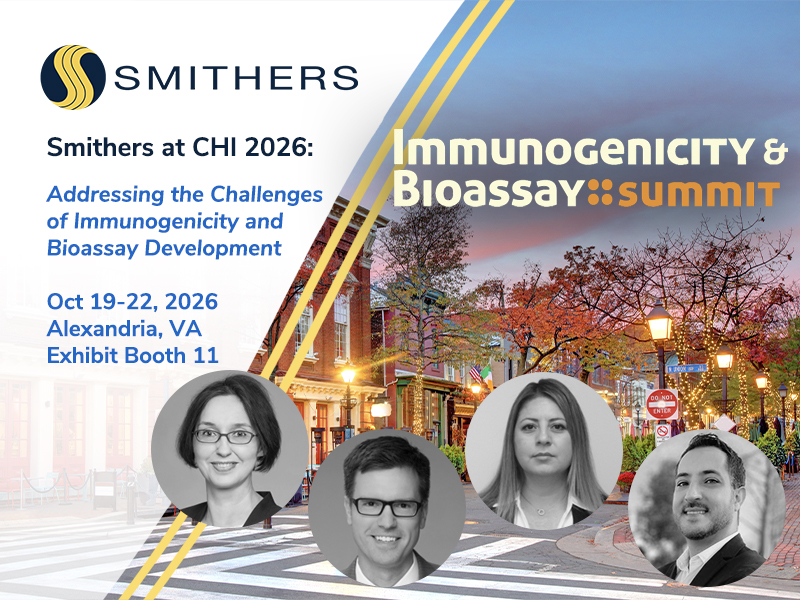
Smithers Pharmaceutical Development Services will join scientists, drug developers, and industry leaders at CHI's 18th Annual Immunogenicity & Bioassay Summit, taking place October 19–22, 2026, in Alexandria, Virginia. The conference provides an opportunity to discuss the evolving challenges associated with immunogenicity assessment, bioassay development, assay performance, and the interpretation of clinically meaningful data.
These challenges are becoming more complex as sponsors advance increasingly sophisticated biologics and therapeutic modalities. Reagent consistency, drug tolerance, assay design, platform selection, and data interpretation can all affect the reliability of immunogenicity results and the timelines required to generate them.
Smithers will bring scientific and bioanalytical expertise to these discussions, with Director of Science Nadia Kulagina, Associate Director Nick Doperalski, Associate Director Adriana Lopez, and Senior Business Development Administrator Ignacio Reynoso representing Smithers throughout the conference at exhibit booth 11.
Reagent Consistency Can Affect Immunogenicity Assay Performance
Reagent consistency is an important consideration in immunogenicity assay development and execution. Changes between reagent lots can affect assay performance and create variability that may require additional investigation or optimization.
Positive controls, detection reagents, and other assay components need to perform consistently enough to support reliable results. When a new reagent lot does not perform as expected, scientists may need to characterize the lot, troubleshoot assay performance, or identify and qualify an alternative reagent.
Availability can create another challenge. Some reagents are dependent on external suppliers, while others may become unavailable during the course of a development program. Replacing a critical reagent can require additional work to demonstrate that the new reagent supports comparable assay performance.
These considerations can affect development timelines when programs are moving quickly from method development into validation and sample analysis.
Complex Molecules Can Require More Complex Immunogenicity Assays
The analytical strategy required for a straightforward biologic may not translate directly to a more complex therapeutic.
Bispecific and multispecific molecules can introduce additional considerations because the therapeutic contains multiple binding domains or functional components. Smithers addresses these challenges through bioanalytical strategies for bispecific therapeutics, including custom assay approaches designed around the complexity of these molecules.
Drug tolerance can be particularly challenging. High concentrations of therapeutic drug in study samples can interfere with the detection of anti-drug antibodies (ADAs), potentially masking an immune response. Addressing that interference may require changes to assay conditions, reagent selection, or other elements of the method.
As assay complexity increases, development and validation can require additional time. A multi-tier immunogenicity strategy can involve substantially more development work than a conventional assay, making early planning important for programs with aggressive timelines.
Immunogenicity Strategy Should Account for the Entire Development Program
Immunogenicity testing should not be treated as an isolated analytical activity. The assay strategy needs to reflect how the resulting data will be used throughout development.
ADA testing provides information about whether an immune response has developed. Neutralizing antibody (NAb) testing provides additional information about whether that response affects the biological activity of the therapeutic. Interpreting the two together can help sponsors determine whether detected antibodies have potential implications for drug exposure, efficacy, or other clinical outcomes.
For sponsors developing biologics, ADA and NAb assay strategies need to account for the characteristics of the therapeutic, the intended use of the data, and the requirements of the development program.
The therapeutic itself also influences assay strategy. Molecular structure, mechanism of action, expected drug concentrations, sample characteristics, and the intended use of the data can affect method design and platform selection.
Early consideration of these factors can help identify potential assay challenges before they affect later development activities.
Fit-for-Purpose Assay Development Supports Reliable Data
A fit-for-purpose approach means designing an assay around the scientific question and the intended use of the data.
Assay development may need to address sensitivity, specificity, selectivity, precision, drug tolerance, matrix effects, reagent performance, and other characteristics. The appropriate requirements depend on the therapeutic, study stage, assay type, and regulatory expectations.
Platform selection is another consideration. Smithers uses multiple analytical platforms for bioanalytical method development, including ELISA, MSD, Singulex, Gyrolab, Quanterix, AlphaLISA, and ELISPOT.
The appropriate platform depends on the characteristics of the molecule and the analytical objective. A platform should support the scientific requirements of the program rather than be selected solely because it has been used successfully for another therapeutic.
Interpreting ADA and NAb Data Requires Context
An immunogenicity result requires scientific interpretation.
Detection of an ADA does not necessarily mean that the antibody will alter the therapeutic's biological activity. Additional characterization can help determine whether detected antibodies have neutralizing activity and whether the immune response has a meaningful effect on the drug.
NAb testing provides an additional layer of information. NAb assays evaluate whether antibodies interfere with the biological activity of a therapeutic and can use cell-based or cell-free formats depending on the mechanism of action and assay requirements.
Sponsors also need to consider the relationship between immunogenicity findings and other clinical or bioanalytical data. The objective is to understand the significance of the immune response rather than evaluate an ADA or NAb result in isolation.
Emerging Modalities Add New Bioanalytical Considerations
Immunogenicity strategies must continue to evolve as new therapeutic modalities enter development.
The 2026 CHI Immunogenicity & Bioassay Summit will address immunogenicity considerations for emerging and complex modalities, including peptides, bispecifics and multispecifics, T-cell engagers, oligonucleotides, cell and gene therapies, ADCs, and other next-generation therapeutic platforms.
These programs can introduce analytical considerations that differ from traditional biologics. Scientists may need to evaluate different assay formats, reagent requirements, interference mechanisms, or biological endpoints.
Continued engagement with developments in immunogenicity and bioassay science helps analytical teams evaluate whether established approaches remain appropriate and where alternative technologies may provide value.
Scientific Expertise and Communication Support Bioanalytical Programs
Technical capabilities are only one component of an effective bioanalytical program. Early scientific discussions can help identify potential challenges before method development begins.
Smithers scientific team works with sponsors to understand the intended use of the method, expected timelines, sample availability, and other program requirements. That information helps inform method development and identify issues such as reagent availability before they create avoidable delays.
Smithers also maintains communication throughout development, with project updates tailored to the sponsor's preferred level of involvement. Some sponsors want detailed visibility into method development activities, while others prefer Smithers to manage the analytical work with concise updates tied to key milestones.
This collaborative approach is particularly relevant to ADA program development, where sponsors may need consistent communication as assay development, validation, and sample analysis progress.
Smithers Pharmaceutical Development Services supports large-molecule bioanalysis through assay development, validation, and sample analysis across multiple therapeutic modalities.
Connect With Smithers at CHI's 18th Annual Immunogenicity & Bioassay Summit
Smithers will participate in CHI's 18th Annual Immunogenicity & Bioassay Summit, taking place October 19–22, 2026, in Alexandria, Virginia. The summit brings together industry, academic, and regulatory experts to discuss immunogenicity assessment, clinical relevance, immunogenicity prediction and control, and bioassay development.
Director of Science Nadia Kulagina, Associate Director Nick Doperalski, Associate Director Adriana Lopez, and Senior Business Development Administrator Ignacio Reynoso will represent Smithers throughout the conference at exhibit booth 11.
The program includes discussions around fit-for-purpose assay development and validation, drug and target interference, interpretation of clinically meaningful ADA data, and strategies for complex therapeutic modalities.
For scientists and drug development teams working through immunogenicity or bioassay challenges, the conference provides an opportunity to discuss analytical strategies, emerging approaches, and practical development considerations with Smithers' scientific team.
Discuss Immunogenicity and Bioassay Development with Smithers
Sponsors developing complex biologics need bioanalytical strategies that account for the scientific and operational challenges that can affect assay performance and development timelines.
Smithers Pharmaceutical Development Services provides immunogenicity testing, ADA and NAb assay development and validation, bioassay support, and broader bioanalytical services designed around the requirements of individual development programs.
Schedule a meeting with Smithers ahead of CHI's 18th Annual Immunogenicity & Bioassay Summit or connect with the team at the Smithers exhibit booth 11 in Alexandria, Virginia, October 19–22, 2026