Beyond the Data: Why the Right CRO Partnership Matters When Challenges Arise
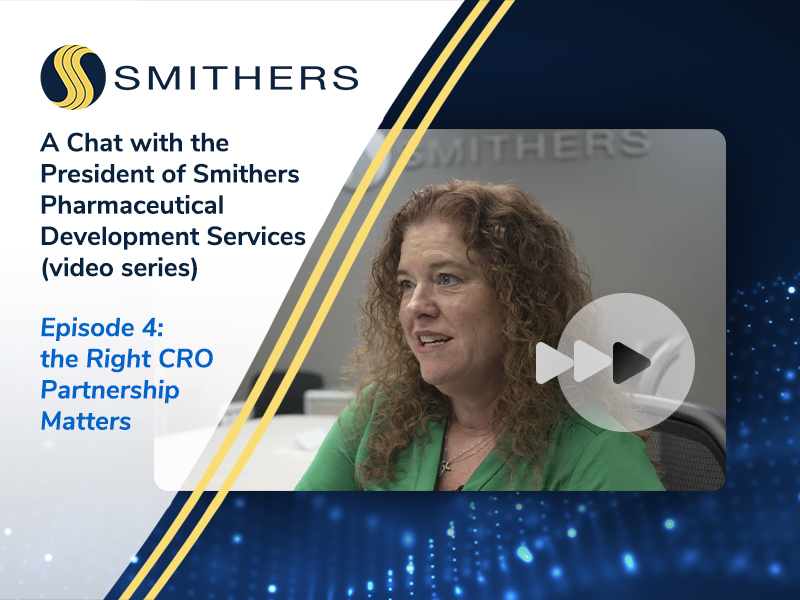
Drug development programs depend on good science, reliable data, and experienced laboratory teams. But sponsors evaluating a contract research organization (CRO) are choosing more than a laboratory. They are choosing a team they will depend on to communicate clearly, understand their objectives, anticipate challenges, and help keep a program moving forward.
In the latest video in the Smithers Video Series, “A Chat with the President”, Christina Satterwhite, PhD, President of Smithers Pharmaceutical Development Services, discusses the customer service philosophy behind that relationship. At Smithers, supporting a client means understanding what they are trying to accomplish and taking ownership of those goals alongside them.
That approach becomes particularly valuable when a program does not go exactly as expected.
Partnership Is More Than Delivering Results
Sponsors understandably expect their CRO partners to provide accurate, high-quality data on schedule. But successful outsourcing relationships require more than completing the work defined in a scope or protocol.
Every development program has its own scientific questions, timelines, regulatory considerations, and operational pressures. An effective CRO partner needs to understand those broader objectives and recognize how the work being performed in the laboratory contributes to them.
That means communication cannot be limited to reporting results after work has been completed. It requires ongoing collaboration between the sponsor and scientific team, with both sides working toward the same development milestones.
Smithers Pharmaceutical Development Services has built its customer service philosophy around that kind of partnership. Scientists are not simply responsible for performing an assay or processing samples. They understand that their work is part of a larger program and that the sponsor is depending on them to help achieve an important objective.
Transparency Matters Most When Challenges Appear
In pharmaceutical development, even carefully designed programs can encounter unexpected results or technical roadblocks. An assay may behave differently with a particular matrix. A method may require additional optimization. Sample characteristics may introduce complications. A development strategy that appeared straightforward at the beginning may need to evolve as new information becomes available.
These situations are precisely when transparency becomes essential.
A strong CRO partner communicates potential issues early, explains what is happening, and works with the sponsor to determine the most appropriate path forward. That transparency gives sponsors an opportunity to make informed decisions while there is still time to protect important milestones.
As Christina explains in the video, the goal cannot be to deliver good news all the time. The goal is to provide clients with an accurate understanding of their program and the expertise necessary to navigate whatever challenges arise.
For sponsors working toward critical data deliveries, clinical milestones, or regulatory submissions, that distinction can be significant.
Bringing Collective Expertise to Complex Problems
Complex scientific challenges do not always fit neatly within a single discipline. Solving them may require input from scientists with different technical backgrounds, regulatory experience, or knowledge gained from similar programs.
That is why Smithers PDS takes a collaborative approach to problem-solving.
When a difficult question emerges, the client is not limited to the perspective of the individual scientist assigned to the project. Smithers can bring together expertise from across the organization to evaluate the issue, identify potential solutions, and determine how best to proceed.
This collective approach is particularly valuable because Smithers PDS supports bioanalytical programs across multiple stages of development. Experience with assay development, validation, regulated bioanalysis, clinical sample analysis, and sample management provides teams with a broader perspective on how decisions made today may affect the program later.
The objective is not simply to solve the immediate technical problem. It is to help solve it efficiently and in a way that supports the sponsor’s larger development strategy.
Protecting Timelines Through Communication and Experience
Time matters throughout pharmaceutical development. When an unexpected issue occurs, the speed with which it is identified, communicated, and addressed can directly affect downstream activities.
Waiting too long to escalate a concern can turn a manageable technical issue into a scheduling problem. Delays in one area can affect sample analysis, data delivery, subsequent studies, or other program milestones.
Experienced teams understand those dependencies. They can recognize potential roadblocks, bring the appropriate people into the discussion, and begin evaluating solutions before valuable time is lost.
This is where customer service and scientific expertise become inseparable. Responsiveness is valuable because it is backed by people capable of understanding the problem and helping determine the next step.
A CRO Team Invested in the Same Goal
Ultimately, the best sponsor-CRO relationships are built around a shared objective: moving the program forward with reliable science and the information necessary to make confident decisions.
For Smithers Pharmaceutical Development Services, customer service means being accessible, transparent, collaborative, and willing to bring the organization’s collective expertise to the table when clients need it.
Successful programs will always depend on high-quality laboratory work. But when challenges arise, sponsors also need a partner that will communicate openly, work through problems alongside them, and remain focused on the milestones that matter to their program. That is the difference between outsourcing laboratory work and building a scientific partnership.
 Registration for this event has closed.
Error: The webinar is full. Please contact the webinar’s host if you feel this is a mistake.
Error: This email address is already registered for this event. Please contact the webinar host if you have any questions.