The Future of Flexographic Printing to 2031
The definitive outlook for the global flexo printing market, this report delivers detailed market data by end-use application and region to 2031.
New research from Smithers, the global authority on the packaging and printing industries, finds that the flexographic printing market is returning to growth. According to its latest report, The Future of Flexographic Printing to 2031, the market will grow from $260.1 billion in 2026 to $299.6 billion in 2031, a CAGR of 2.9% in value, while volume rises by 3.0% a year. This follows five years in which value grew by just 0.4% a year and volume fell by 1.0% a year.
Corrugated and flexible packaging dominate the market, together accounting for 77.1% of flexo print value and 73.2% of volume in 2026. Corrugated demand peaked in 2021, as high consumer spending on packaged goods coincided with an e-commerce boom. It then fell in 2022/23 as e-commerce normalised. Smithers expects steady growth to 2031, although corrugated volumes in Europe and North America will not return to their 2021 levels.
Asia Pacific is by far the largest and fastest-growing market for flexo, with demand rising across most packaging categories. Its corrugated market dipped only slightly after 2021 and quickly recovered. Meanwhile North America and Europe are seeing sluggish growth, and other regions are smaller and growing slowly.
Packaging segments are resilient. Flexible packaging is growing in real terms in every region, although value is lagging volume as prices have not kept up with inflation. Labels and cartons have kept pace with inflation globally.
Graphic printing is changing, with sanitary and kitchenware products growing steadily, while all other segments are declining. Newspapers see the sharpest decline as circulations shrink and coldset web offset competes for work.
New presses are reshaping the installed base. The number of flexo presses in operation is falling, in some cases sharply, as faster and more efficient machines replace older fleets. New press sales are buoyant, led by wide and medium web. Medium web is growing as label and flexible packaging converters target short-run flexible packaging. Narrow web is declining, partly due to competition from digital presses, although hybrid label presses are increasingly popular. Automation, often incorporating AI, is helping converters tackle skills shortages.
Consumables demand is growing despite supply pressures. Flexo ink demand is outpacing print volume, because flexible packaging uses several colours at high coverage, whereas much corrugated work is low-coverage and monochrome. Demand for plates and sleeves follows print volume more closely, and a downturn in 2022–24 for both consumables is now reversing. Meanwhile, conflict in the Middle East and oil shortages in parts of the world are pushing up raw material prices and causing shortages of some materials needed for inks, plates and plastics.
Flexo printing output by value, 2021–2031 ($ million, constant 2025 prices & exchange rates)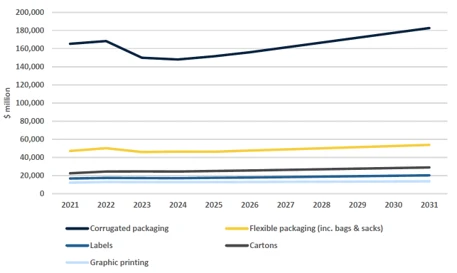
Source: Smithers
The Future of Flexographic Printing to 2031 provides comprehensive data and forecasts on flexo print value and volume by end-use segment and region. It includes analysis of inks, pre-press consumables, the installed base and new press sales, and the drivers shaping the global flexographic printing sector.